At a business dinner, the host orders the wine, and the safest order is one bottle from the middle of the price list in a style most people like, chosen quickly and without a speech. If you are the host, that means a medium red or a crisp white, a short word with the server, and back to the conversation. If you are a guest, leave the list alone unless someone hands it to you.
The rest of this guide covers the parts that make people nervous: how much is reasonable on someone else's card, how to cover a table that ordered steak, salmon and a salad, and what to do when the server pours that little taste while six people watch.
who orders, and why it is usually the host
The host is whoever extended the invitation or whose company is picking up the check. Ordering the wine is part of hosting, the same as choosing the restaurant. If you are the host, you do not need to be the wine person at the table. You need to make one reasonable decision and move on.
If you are a guest and the host says "you seem to know wine, why don't you pick," take it as a courtesy, not a test. Keep it quick, keep it mid-priced, and say what you are doing out loud: "I'll grab something easy that works with a bit of everything." That one sentence tells the table you are not about to order the most expensive thing on the page.
If a client is hosting you, let them lead. If they ask what you would like, name a style rather than a bottle ("a lighter red would be great") so they keep control of the price.
what to spend when it is not your money
Before you sit down, know your company's expense policy on alcohol. Some firms cap it, some do not reimburse it at all, and finding out after the fact is a bad way to end a good dinner. If there is no written rule, the unwritten one is simple: stay in the middle of the list.
Most restaurant lists run from a cheap house option to a few showpiece bottles. The sensible zone is the middle third. It reads as generous without looking like you are treating the dinner as a party, and it tends to be where restaurants put the bottles they are proud of. The cheapest bottle on a list is often the one with the biggest markup anyway, so skipping it is not a splurge.
If you want to know why the numbers look the way they do, here is how restaurant wine pricing actually works. The short version: a bottle priced at a few times what it costs in a shop is normal, and nobody at the table is judging you for it.
Never say a price out loud. If you talk to the server or sommelier, point to a bottle in your range on the list and say "something around here." They know exactly what you mean and will stay there.
one bottle for a table that ordered everything
A business table never orders in a tidy way. Someone has the ribeye, someone has the halibut, someone has a salad because they have another dinner tomorrow. You are not going to pair each plate. You are going to pick a wine that stays out of the way of all of them.
Styles that do that job well:
- Pinot Noir, a light red with soft texture and red-berry flavor that works next to fish and meat alike.
- A medium red from the Rhône or Rioja, which has a bit more weight than Pinot without the mouth-drying grip of a big Cabernet (that grip comes from tannin, the compound that makes strong tea feel dry).
- Sauvignon Blanc or an unoaked Chardonnay, meaning one aged in steel rather than wood, so it tastes fresh and citrusy instead of buttery.
- A dry sparkling wine like Crémant or Cava, which is cheaper than Champagne and goes with almost any food you can order.
Skip the heavy hitters. A huge, tannic red or a sweet dessert wine divides a table. You want the bottle people forget about because it just worked.
bottle or glasses: count the drinkers first
A standard bottle pours about five glasses. Before you order, do a quiet head count of who is actually drinking. Two or three drinkers at a table of six means glasses, not a bottle. Four to six drinkers means one bottle, and if the food is split between meat and fish, one red and one white covers everyone. Larger tables scale from there, one bottle for every four or five drinkers.
Plenty of people at business dinners do not drink, for all sorts of reasons, and none of them owe you an explanation. Order sparkling water for the table with the same care you give the wine, and never top up a glass that is being nursed. This is a working meal. One or two glasses over a couple of hours is the norm, and the person who keeps pace with the slowest drinker at the table always looks the most in control.
the ten-second conversation with the server
You do not need to study the list. You need one sentence: "We've got a mix of dishes coming. Could you suggest a red that works across the board, something around here?" Then point at your price zone. A good server or sommelier will give you two options in a few seconds. Pick one. Done.
If you want more phrasing to lean on, these exact phrases for talking to a sommelier cover budget, taste and food without using a single wine word. And if the list itself looks like a phone book, this guide to reading a wine list in about a minute shows you where the sensible bottles usually sit.
If you would rather not think about it at all mid-conversation, Green Glass reads a photo of the wine list, checks each bottle against a quick taste profile that includes your budget, and hands you one pick with a one-line reason you can repeat to the table.
the tasting pour, with the whole table watching
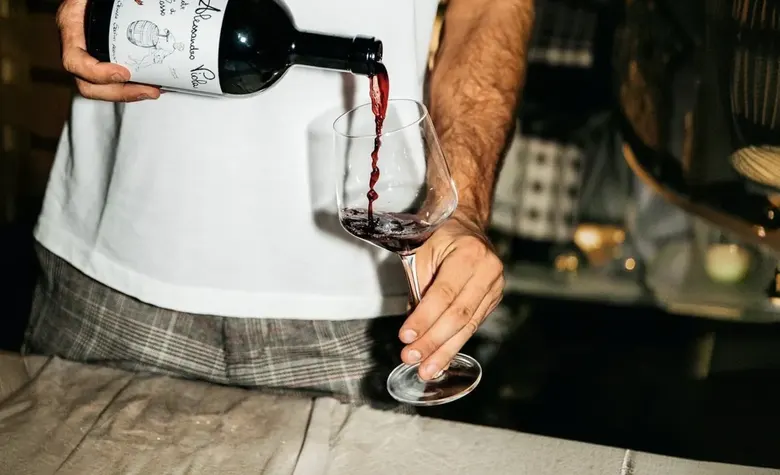
The server will show you the label, open the bottle, and pour a small splash in your glass. This is not a quiz on whether you love the wine. It is a check that the bottle is not faulty. Glance at the label to confirm it is what you ordered, take one sip, and say "that's great, thank you."
Send it back only if something is clearly wrong: it smells like wet cardboard or a damp basement (that is a corked bottle, a cork fault, and nobody's fault) or it tastes sharp and vinegary. "I don't love it" is not a reason at a business dinner. Swapping bottles in front of a client turns a two-second moment into a five-minute one.
The server will pour for your guests first and you last. Let them. If someone covers their glass with a hand, that means no thanks, and it needs no comment from anyone.
small moves that make it look easy
Order the wine right after the food order, not before. That way you know whether the table went meat-heavy or fish-heavy, and the server can steer you. If the group is still settling in and you want something on the table, a bottle of sparkling to start is a graceful move that buys time.
Do not narrate the wine. One line is fine ("this is a Pinot from Oregon, it should be easy with everything"), and then let it go. People remember the conversation, not the bottle. If a guest clearly knows more than you, ask them one question about it and enjoy the answer. That is good hosting, not weakness.
When the check comes, ask for an itemized receipt. Many expense systems want to see the alcohol separated from the food, and it is much easier to ask the server now than to email the restaurant next week.
That is really it. One mid-priced, crowd-friendly bottle, ordered in a sentence, tasted in a sip. Save your attention for the people at the table.
questions people ask
Who should order the wine at a business dinner?
The host orders, meaning the person who extended the invitation or whose company is paying. If the host hands you the list, pick one mid-priced, crowd-friendly bottle quickly and say what you are doing so the table knows you are not reaching for the top shelf.
How much should you spend on wine at a business dinner?
Stay in the middle third of the list's price range, and check your company's expense policy on alcohol before the dinner. Never say the number out loud; point to a bottle in your range and ask the server for something around there.
Should you order a bottle or glasses for a business table?
Count who is drinking first. Two or three drinkers means glasses, four to six means one bottle (which pours about five glasses), and a bigger table with mixed dishes does well with one red and one white.
Is it OK not to drink at a business dinner?
Yes. Say "I'm good with water tonight" and leave it there. Nobody worth doing business with will push, and the host should order sparkling water for the table without making it a thing.
What do you do when the server pours a small taste for you?
Take one sip to check the wine is not faulty, then say thank you. Send it back only if it smells like wet cardboard or tastes like vinegar, not because you would have preferred a different style.