Serve most red wine around 60 to 65 F, which is cooler than your living room. The easiest way to get there is to put the bottle in the fridge for 15 to 20 minutes before you open it.
That one habit fixes more red wines than any decanter or fancy glass. Warm red wine tastes boozy and flat. Slightly cool red wine tastes brighter, fresher and more like fruit. Here is why the old advice steers you wrong, what the right range feels like, and how to hit it with nothing but a kitchen fridge and a timer.
"room temperature" is a myth (or at least a very old room)
You have probably heard that red wine should be served at room temperature. The problem is the room. That advice comes from older European houses, where a dining room or cellar might sit in the high 50s or low 60s F for much of the year. Nobody had in mind a modern American living room with the thermostat set to 70 or 72 F.
At 72 F, a red wine is roughly ten degrees warmer than it wants to be. Alcohol evaporates faster as the wine warms, so the first thing you smell is a hot, spirit-like whiff instead of fruit. The wine feels heavier and softer in your mouth, and the fruit flavor fades into the background. Many sommeliers will tell you that the most common serving mistake with red wine is not serving it too cold. It is serving it too warm.
what red wine tastes like when it is too warm
Pour a glass straight from a cabinet in a warm kitchen and you will notice a few things. The nose smells of alcohol first, a bit like warm brandy. The fruit tastes jammy and tired. The wine feels soupy and loses its edges, so a Cabernet that should be firm and structured comes across as flabby instead.
A quick test: if you take a sip and your first thought is "that is strong" rather than "that is cherry" or "that is blackberry," the wine is probably too warm. Cooling it a few degrees usually brings the fruit back.
what red wine tastes like when it is too cold
Red wine can go too far the other way. Pull a bottle out after a couple of hours in the fridge and the aromas close up. You get very little smell, and the wine tastes thin and sharp. Tannin (the drying, grippy feeling you get from strong black tea) turns harsher and more bitter when a red is cold, which is why a big Cabernet or Syrah served fridge-cold can feel like chewing on a tea bag.
The good news is that too cold is the easy problem. A glass warms up on its own just sitting on the table. Cup the bowl of the glass in your hands for a few minutes and it warms faster. Too warm is harder to fix in a hurry, which is why it pays to start a little cool and let the wine drift up.
red wine temperature cheat sheet by style
Nobody expects you to hit an exact number. These are the ranges many sommeliers aim for, and landing within a few degrees is plenty.
- Light, fresh reds (Pinot Noir, Gamay, Beaujolais, Barbera, Valpolicella): 55 to 60 F. These are all about bright fruit and perfume, and they taste best with a real chill on them.
- Medium-bodied reds (Merlot, Sangiovese and Chianti, Grenache, Tempranillo and Rioja, Zinfandel): 60 to 63 F. Cool enough to stay fresh, warm enough for the fruit to open up.
- Big, bold reds (Cabernet Sauvignon, Syrah and Shiraz, Malbec, Petite Sirah, Nebbiolo): 63 to 65 F. These carry the most tannin and alcohol, so they want the top of the range. Any cooler and the tannin gets harsh. If you are opening a Napa Cabernet, this is your zone.
- Reds meant to be chilled (Lambrusco, pet-nat and other sparkling reds, anything sold as a "chillable red"): 50 to 55 F. Treat them almost like a white.
A common rule of thumb: the lighter the color in the glass, the cooler the wine likes to be. Nearly see-through? Chill it more. Opaque purple-black? Chill it less.
how to get the temperature right without a thermometer
You do not need a wine fridge or a gadget. Your kitchen fridge is far colder than any red wants to be, so you are only borrowing it for a few minutes. Here is the routine:
- Big red at room temperature: 15 minutes in the fridge, then open and pour.
- Light red at room temperature: 20 to 30 minutes in the fridge.
- Red that has been in the fridge for hours: take it out 30 to 45 minutes before pouring, or just pour it and cup the glass in your hands.
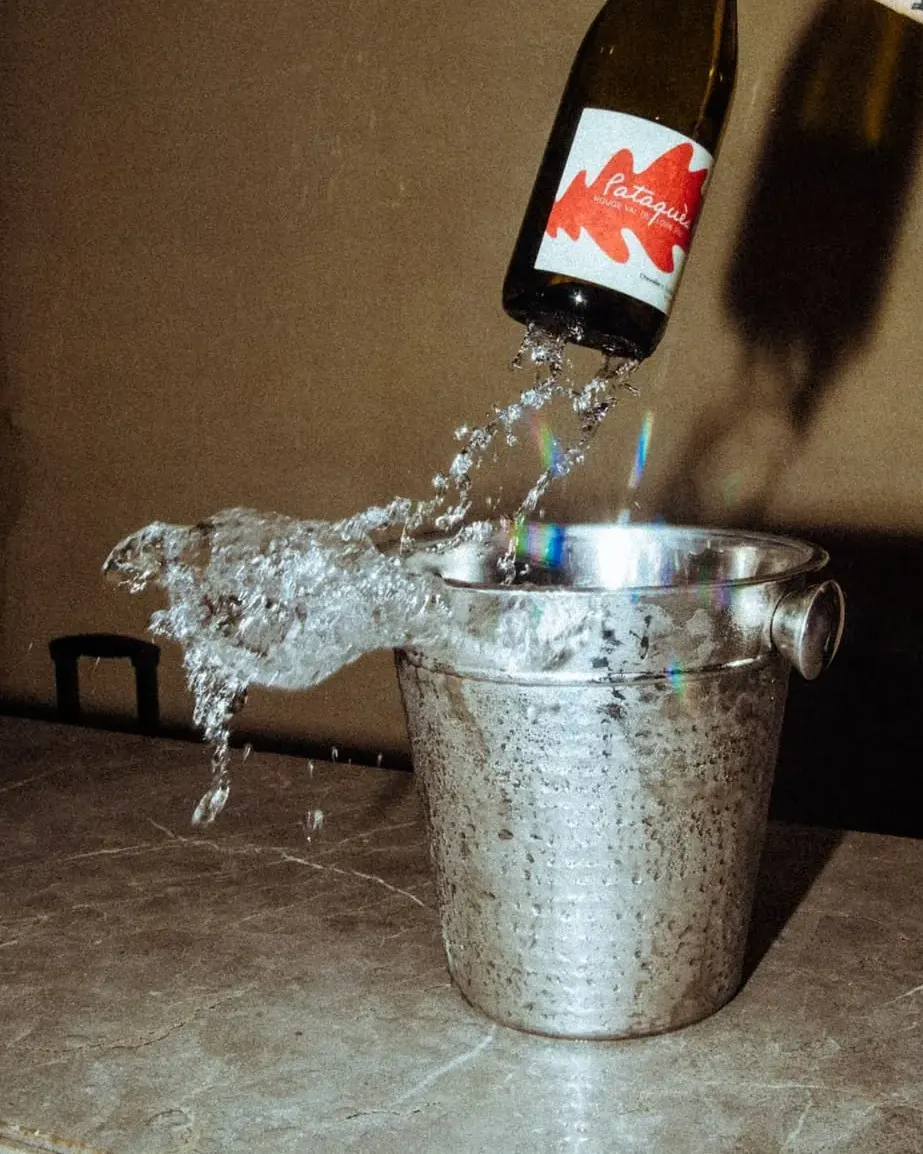
- In a hurry: an ice bucket filled half with ice and half with water, 5 to 8 minutes. Ice water pulls heat out of the bottle much faster than the fridge or ice alone.
- The hand check: the bottle should feel cool to the touch, like a cool basement wall, not cold like a can of soda. If it feels like nothing at all, about the same as your hand, it is too warm.
Once poured, the wine in your glass creeps toward room temperature over the next 15 to 20 minutes. If you started a little cool, that gives you a natural window where the wine keeps improving as you drink it, rather than getting worse.
Try this at home one evening: pour the same red at two temperatures and compare them side by side. It is one of the fastest ways to train your palate, and it pairs well with the basics in our guide to how to taste wine.
what to do about red wine temperature at a restaurant
Restaurants are often warm, and bottles kept on a shelf behind the bar or on a display rack can be sitting at 72 F or higher. If the server pours a red and it tastes boozy and flat, it is completely fine to ask for an ice bucket for a few minutes. Servers hear this request all the time, and many sommeliers do it themselves before a bottle ever reaches your table. Five to ten minutes in ice water is usually enough.
Keep it casual: "Could we get an ice bucket for this for a few minutes? It is a little warm." Nobody will think you are being difficult. If anything, it signals that you know what you are doing. Picking the bottle in the first place is usually the harder part, and we cover that in how to order wine at a restaurant without feeling lost. If you want help narrowing a long list down to one bottle that fits your taste, that is exactly what Green Glass is built for.
The short version: cooler than the room, warmer than the fridge. Fifteen minutes in the fridge before you open a red is the simplest upgrade in wine, and it costs nothing.
questions people ask
What temperature should red wine be served at?
Most red wine shows best between 60 and 65 F. Lighter reds like Pinot Noir and Beaujolais are better around 55 to 60 F, and big reds like Cabernet Sauvignon and Syrah sit at the top of the range.
Should you put red wine in the fridge before serving?
Yes, briefly. Put the bottle in the fridge for 15 to 20 minutes before opening to bring it from room temperature down to the low 60s F.
What happens if red wine is served too warm?
The alcohol stands out, the wine smells hot rather than fruity, and the flavor tastes flat and heavy. Cooling the bottle for 15 minutes in the fridge usually brings the fruit back.
Is it OK to ask for an ice bucket for red wine at a restaurant?
Yes. Restaurants are often warm, and five to ten minutes in an ice bucket is a normal request that many sommeliers make themselves before pouring a red.
What should you do if red wine is too cold?
Pour it and cup the bowl of the glass in your hands for a few minutes, or leave the bottle on the counter for 30 to 45 minutes. Too cold fixes itself quickly, while too warm takes more effort.